The history of the Vakhiyo valley from the 12th to the 21st century
12th — 16th centuries
The history of the Vakhiyo valley goes back deep into the Middle Ages. In the 12th–14th centuries the territory of Vakhiyo lay within the historical space of the mountain regions of Central Asia. However, very few written records have survived that would allow the events in the Vakhiyo valley itself to be reconstructed consistently for this period. Under Mongol rule written information about Vakhiyo becomes especially scarce, so for this time it is impossible to reliably establish a continuous sequence of local rulers and events. This lack of written records does not mean that there was no population or political life in the valley itself.
In the following centuries Vakhiyo gradually became part of larger political unions of mountain Tajikistan. In the 16th century the territory of Vakhiyo was drawn into the political processes between the various rulers of Eastern Bukhara. This was a time of struggle for power, shifting political centres and the strengthening of local ruling families. Gradually Vakhiyo became ever more closely tied to the political system of Darvaz.
The Darvaz shahdom: 17th — 18th centuries
In the 17th century Darvaz became an independent political domain, and the Vakhiyo valley became part of its political system. Among the rulers of this period Shah Kirgiz is mentioned, whose reign dates to the 17th century. During this period Vakhiyo developed within the Darvaz shahdom, while local influential families gradually strengthened their role in governing the population and the land.
In the 17th–18th centuries Darvaz maintained complex political relations with neighbouring domains, especially Badakhshan. Among the rulers of this period Mir Sultan Shah is mentioned. In the 18th century the struggle between the various political forces of the mountain regions continued. Vakhiyo remained part of the Darvaz shahdom, while the local nobility, religious families and military men gradually gained more and more importance.
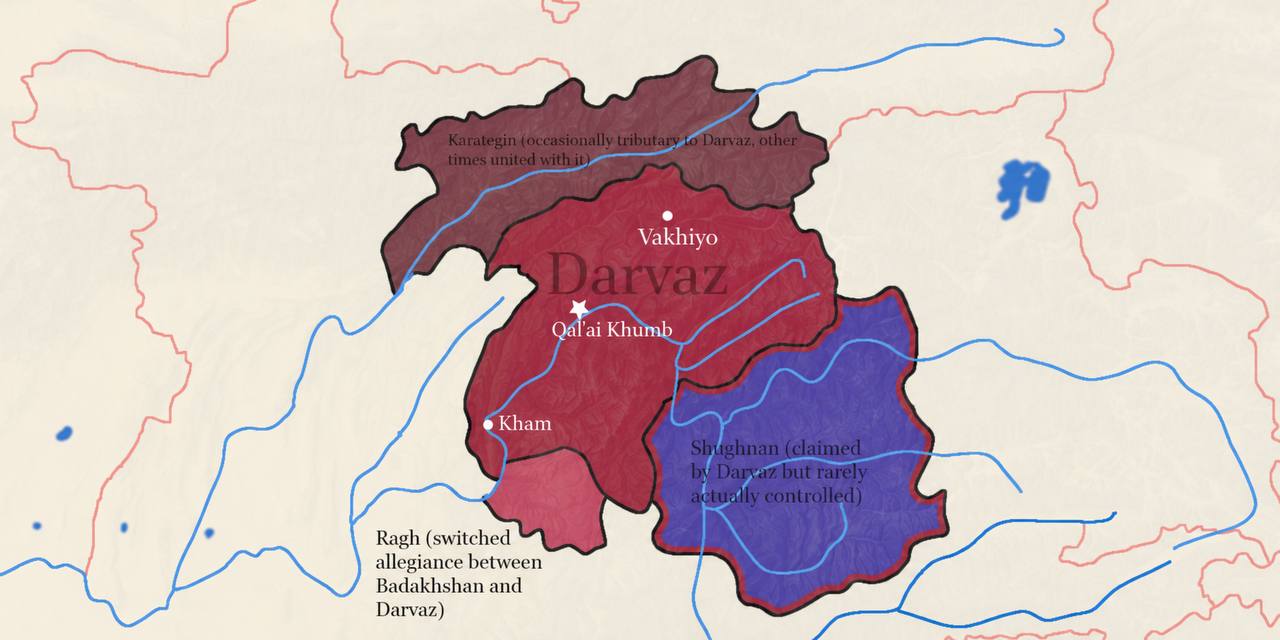
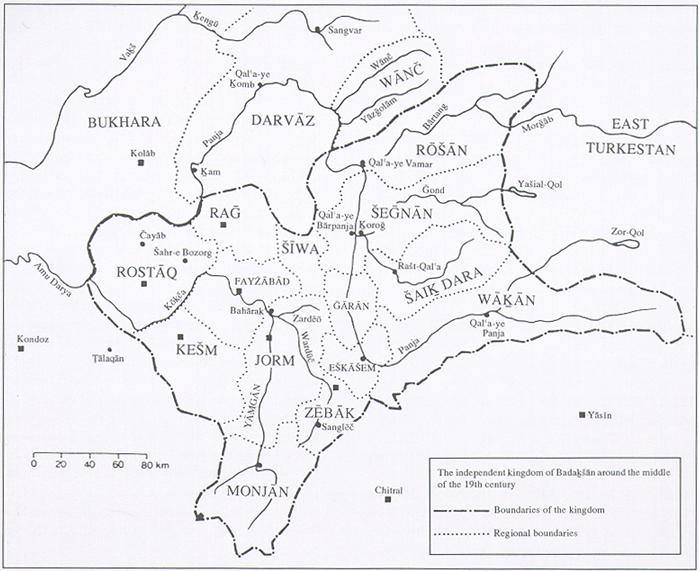
Darvaz also held sway over neighbouring mountain domains. At different times Wakhan, Rushan and Shughnan were vassals of Darvaz and paid it tribute. These relations show the wider political system of Darvaz, in which Vakhiyo held an important place. The nature and duration of the dependence of individual domains could change from period to period.
The 19th century: Vakhiyo within Darvaz
In the 19th century the history of the Vakhiyo valley becomes much easier to trace. Vakhiyo remained part of the Darvaz shahdom. Vakhiyo-Bolo, Tavildara, Childara and Sagirdasht were parts of a single historical Vakhiyo valley. In administrative sources they could be treated as separate amlokdorships or subdivisions, but historically they all belong to the Vakhiyo valley.
In the first half of the 19th century the political position of Darvaz changed under the influence of neighbouring states. In the 1820s–1830s Karategin was united with Darvaz. In 1839 Darvaz fell into dependence on Kokand and had to pay it tribute. Later the independence of Darvaz grew stronger again.
Makhmad Negmon-Biy and his descendants
In this period an important place in the history of Vakhiyo is held by Makhmad Negmon-Biy, one of the most influential figures of Vakhiyo-Bolo. He came from an influential family which local tradition linked to settlers from Khorezm. The common ancestor of the family was said to be Mizrob. Negmon-Biy lived in Naiguft, held considerable tankho estates and had great influence in the Vakhiyo valley.
Besides being a major landowner and a member of the local nobility, Makhmad Negmon-Biy is known in historical tradition as a military leader. According to the accounts that have come down to us, he defeated the Kyrgyz in Lakhsh, Khait and Tajikabad. After these clashes the people of Vakhiyo drove the Kyrgyz out of Karategin and settled these lands. As a result of this later settlement a large part of the population of Lakhsh, Khait and Tajikabad came from Vakhiyo. These events were an important stage in the spread of the people of Vakhiyo beyond the valley itself.
Shahmansur, the son of Makhmad Negmon-Biy, later became one of the well-known military figures associated with Vakhiyo and Darvaz. He came from Naiguft in the Vakhiyo valley and continued his family's military tradition. Shahmansur took part in the campaigns of the Darvaz shahdom and became famous for his victories, including the campaign against Hisor. The military activity of Shahmansur thus continued the influence of Negmon-Biy's family, which held an important position in the history of Vakhiyo.
Other members of Negmon-Biy's family also played an important role in the 19th century. His relative was Rahim-Biy, who lived in Lojirk. A serious conflict broke out between Negmon-Biy and Rahim-Biy over a bride price: Rahim-Biy demanded a large amount of livestock and money for the bride. Negmon-Biy then gathered his people and moved against Lojirk. In the course of the conflict Rahim-Biy's people were driven out and his house was attacked. This episode shows the strength of individual influential families within Vakhiyo.
Kasym-Bek, who also belonged to this influential family, was associated with Lojirk. Rahim-Biy's father, Karim, received three households in Lojirk as tankho from Shah Iskandar-Khan. Another member of the family, Mir Mihtoj Shah, was associated with Naiguft and brought up the young Olim-Khan, for which he received tankho. In the 19th century there were various forms of land ownership in Vakhiyo. Kislyakov distinguishes private lands (mulk), lands belonging to the ruler (zamini miri), and common lands and pastures. A large part of the land was granted as tankho. Formally such holdings could be temporary or for life, but in practice they often became hereditary.
Land ownership and the ishans
Another influential group were the ishans of Arzyng. Their influence was especially noticeable in the upper part of the Vakhiyo valley and in Vakhiyo-Bolo. Linked with them were the ishans of Yazgand, whose influence extended to the lower and middle Khingou, including Sagirdasht and Turkiya.
According to local tradition, the ancestor of the Arzyng ishans was Sho Mukhammad, who came from upper Vanj. The people of Arzyng bought him out of slavery and gave him a house, land and a family. His descendants later received a religious education in Bukhara.
Ishon Rahmatullo held a special position. He enjoyed great religious authority, and his family owned tankho. Arzyng, Pashimgar and Gujovas were associated with his name. His influence was so great that his family kept its holdings after the change of political power.
Khudoy Nazar Atalyk, who commanded the Bukharan troops, is linked with the activity of Ishon Rahmatullo. According to one account, Rahmatullo was sent to Darvaz to negotiate with the rebels and was to persuade them to stop resisting.
Another major tankho holder was Mirzo Buzurg from Khur. He came from an influential family regarded as hereditary nobility since the time of the shahs. Mirzo Buzurg held a great deal of tankho, was known as a poet and received the title of inok. Thanks to his connections he had considerable influence over the peasants who belonged to him.
Firuz and his sons Makhmad Amir Sho, Dilovar Sho and Gayrat Sho were connected with land relations. Firuz received considerable lands near Sagirdasht for military service, and his sons continued to own these lands and let them to peasants in exchange for a share of the harvest. Seid-Bek from Kevron also received land for military service.
Nasir Ruzi, who came from Darvaz, received Goudi-Bolo as tankho after marrying a woman from that area. Ishon Sultan and the Arzyng ishans held old tankho linked to religious merit and to earlier generations.
The sources also mention Kozi Seidali, Makhmad Ali-Bek, Kozi Mullo Kurbon Sudur, Mazkhab-Biy, Akbar Tuksobo, Mirzo Nabot Tuksobo, Buzurg Tuksobo, Algafor-Bek Tuksobo, Saidullo Tuksobo, Mullo Davlat-Biy, Abdul Hamid Tuksobo, Makhmarasul Eshikboshi, Odina Makhmud Mirokhur, Makhmad Ali-Bek Mirokhur, Ishon Nuri and Abdurakhmon Mirokhur. They are among the people associated with the system of land ownership, tankho and the local social structure of Vakhiyo.
Local memory has kept the story of Piri Bobi, associated with Starkha near Lojirk. According to tradition he farmed the land but came into conflict with Kiyom-Bek, a relative of Rahim-Biy. The tradition links this conflict with the seizure of part of his land.
The Emirate of Bukhara and the Vose uprising
In 1877 Darvaz was conquered by the Emirate of Bukhara. The last shah of Darvaz was Abulfayzkhan. After the independent shahdom ceased to exist, Darvaz was incorporated into the Emirate of Bukhara. In 1878 Darvaz became a bekdom. The Vakhiyo valley, together with other lands, continued to exist within the new administrative system.
At the end of the 19th century one of the largest peasant uprisings in the region took place in Vakhiyo — the Vose uprising.
Vose was born in Narynj in the Vakhiyo valley, in the Khulaz area. His family left Narynj after conflicts between local people and the bek. Vose grew up a peasant and worked in the fields and on the farm from his youth.
Vose opposed the arbitrary rule of landowners and beks. According to some accounts, even before the uprising he had gained military experience in clashes with the emir's army.
In 1888 Vose became the leader of a major uprising. At the start about 600 people gathered around him. Later other peasants and armed groups joined the movement. Sary-Khan, the former ruler of an independent domain, also supported the rebels.
On Vose's orders the detachments of Hikmat, Nazim, Nazir and Yusuf-Pahlavan moved against the forces of Mirza Akram, the bek of Baljuvan. In the Surkhob area they defeated his forces and captured the fortress of Baljuvan.
After capturing the fortress Vose set up a temporary people's administration. Yusuf-Pahlavan was appointed minister, and Mullanazir Devonbegi received an administrative post.
The emir sent troops under the command of Yakubjan against the rebels. Near Tutkavul Vose's forces put up strong resistance, but the enemy's superiority in weapons and numbers forced the rebels to retreat. At the end of July 1888 the main forces of the rebels were defeated, and Baljuvan was again under the emir's control.
Vose gathered a detachment again and once more took the fortress, but then government troops besieged it. About 130 people were captured and sent to Bukhara. Vose retreated with a small number of supporters into remote areas.
The emir set a large reward for his capture and used bribery, promises, spies and other methods. After one of his companions betrayed him, Vose was seized. He was taken to Shahrisabz. In the autumn of 1888 Vose was executed in Ak-Saray.
Thus Vose holds a special place in the history of Vakhiyo as a native of the valley who led one of the largest uprisings of the late 19th century.
The early 20th century: Ishon Sultan
At the end of the 19th and the beginning of the 20th century the Vakhiyo valley remained part of the political system of the Emirate of Bukhara. In administrative materials of the early 20th century Vakhiyo-Bolo, Tavildara, Childara and Sagirdasht are listed as parts of Darvaz.
In 1895 an agreement between the Russian and British empires led to the division of Darvaz along the Panj. Vakhiyo continued to develop in the eastern part of the historical territory of Darvaz.
In the early 20th century the traditional tankho system still survived. Kislyakov's book gives data on numerous tankho holders in Vakhiyo-Bolo and Tavildara.
After the revolutionary events of 1917 the political situation in Eastern Bukhara changed. A struggle began between Soviet forces, supporters of the emir and local armed groups.
In this period a special place belongs to Ishon Sultan, a native of Yazgan in the Vakhiyo valley. He came from a family of ishans, received a religious education and made three pilgrimages to Mecca and Medina. Thanks to his authority he had great influence among the population.
In 1921 Emir Olim-Khan called on Ishon Sultan to fight against the Soviet troops. Ishon Sultan became one of the leaders of the armed movement in Eastern Bukhara. He joined forces with Fuzayl Maksum.
In March 1921 the forces of Ishon Sultan and Fuzayl Maksum liberated Kalai-Khumb. In June Langar, Khost and Makhalla on the left bank of the Surkhob were liberated. In August 1921 Ishon Sultan was appointed chairman of the Garm regional revolutionary committee, but later rejoined the armed movement.
On 16 February 1922 he took an active part in the liberation of Dushanbe. Later Ishon Sultan was with Enver Pasha in the fighting from Baysun to Baljuvan. He was subsequently executed in Tavildara.
The Soviet era and independence
After Soviet power was established, the traditional system of government was completely reorganised. The old forms of tankho and the former political structures were abolished, and the land passed under state control.
Vakhiyo-Bolo, Tavildara, Childara and Sagirdasht became part of the new administrative system. The population began to take part in collective farming, and traditional forms of land ownership were replaced by Soviet structures.
In the middle of the 20th century there were large-scale resettlements of the population. Part of the people of the Vakhiyo valley were moved from the mountain areas to other parts of Tajikistan. These resettlements changed the demographic structure of Vakhiyo and led to large communities of people from the valley in other districts of the republic.
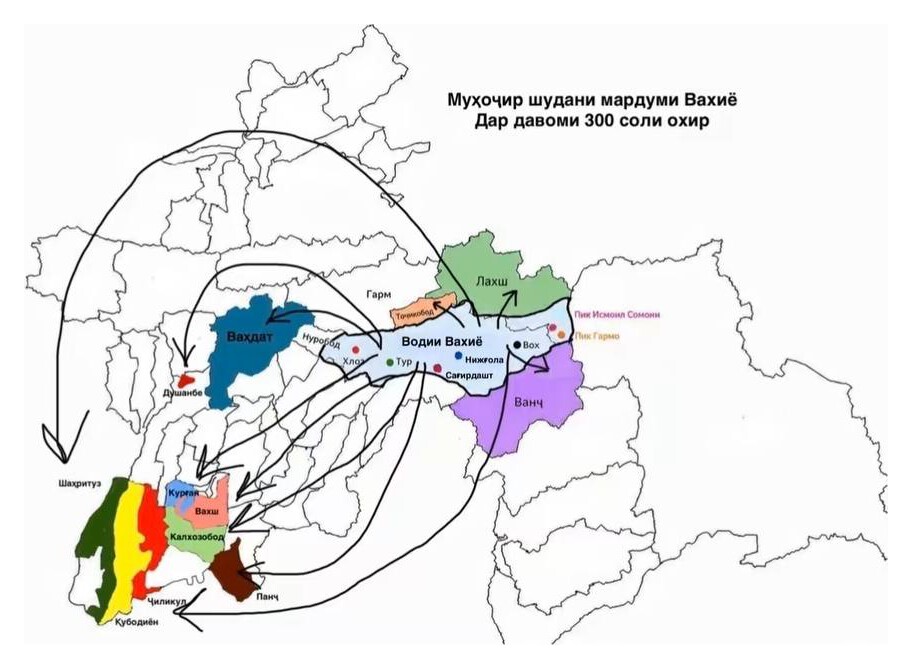
In the Soviet decades the people of Vakhiyo took part in developing agriculture, construction, education and other areas of public life. The old forms of political power disappeared, but the memory of shahs, military leaders, ishans, landowners and peasants continued to be passed on to the next generations.
In 1991 Tajikistan became an independent state. The Vakhiyo valley became part of independent Tajikistan. Today's administrative boundaries do not fully coincide with the historical notion of the valley, but historical Vakhiyo still unites Vakhiyo-Bolo, Tavildara, Childara and Sagirdasht.
Thus the history of the Vakhiyo valley from the 12th to the 21st century is the history of its people, local ruling families, military leaders, religious authorities and political change. For the 12th–14th centuries few written records about Vakhiyo itself have survived. In the 16th century the valley was drawn into the political processes of the mountain regions of Central Asia. In the 17th–18th centuries Vakhiyo became part of the Darvaz shahdom. In this period Darvaz also held vassal influence over Wakhan, Rushan and Shughnan, which at the relevant times paid tribute to Darvaz. In the 19th century Makhmad Negmon-Biy, his son Shahmansur, Rahim-Biy, Ishon Rahmatullo, Mirzo Buzurg and other members of the local nobility became especially important. In the same period, according to historical tradition, the people of Vakhiyo spread their settlement into Karategin after Negmon-Biy's victories in Lakhsh, Khait and Tajikabad. At the end of the 19th century Vose, a native of Vakhiyo, led the major uprising of 1888. At the beginning of the 20th century Ishon Sultan, a native of Yazgan, became one of the best-known participants in the armed events of 1921–1922. After Soviet power was established the traditional system of government and land ownership was abolished, and part of the valley's population was resettled. After 1991 Vakhiyo continued its history as part of independent Tajikistan, preserving the historical memory of its people and of the generations who lived in the valley.